Opinion: How to Prepare Your Fashion Company for AI in 90 Days
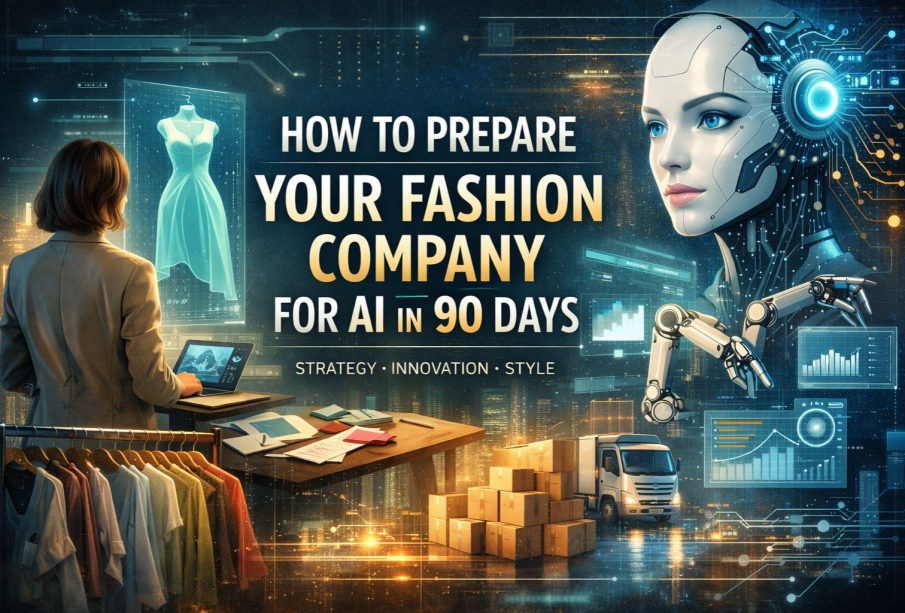
How to Prepare Your Fashion Company for AI in 90 Days
For years, artificial intelligence felt like something that belonged to Silicon Valley, not Paris, Milan, or New York. But today, AI is quietly reshaping fashion from the inside out: predicting demand, accelerating design cycles, personalising customer journeys, and redefining how brands operate at scale.
The good news? Preparing your fashion company for AI does not require a full digital overhaul, a seven-figure budget, or replacing creative talent with machines. What it does require is clarity, leadership, and a focused plan.
Here’s how fashion companies, luxury, contemporary, or emerging, can realistically prepare for AI in 90 days.
Why Fashion Can’t Ignore AI Anymore
Fashion runs on intuition, taste, and timing. AI doesn’t replace those strength, it amplifies them.
Today’s AI tools can:
- Forecast demand more accurately, reducing overproduction
- Analyse customer behaviour in real time
- Speed up design iterations and trend analysis
- Optimise pricing, inventory, and supply chains
- Personalise marketing at scale
In an industry under pressure to become more profitable, sustainable, and responsive, AI is fast becoming infrastructure, not experimentation.
The 90-Day AI Readiness Framework
Think of the next three months as foundation, alignment, and activation.
Days 1-30: Build Understanding Before Buying Tools
1. Educate Leadership First
AI adoption fails when leadership treats it as an IT project. It’s a business transformation.
In the first 30 days:
- Run AI literacy sessions for executives and department heads
- Focus on what AI can and cannot do in fashion
- Address fears around creativity, jobs, and brand dilution
If leadership doesn’t understand AI, the organisation won’t trust it.
2. Identify High-Impact Use Cases
Don’t start with “Where can we use AI?”
Start with “Where are we losing time, money, or insight?”
Common high-value areas include:
- Demand forecasting and inventory planning
- Customer segmentation and CRM
- Merchandising and assortment planning
- Content creation and marketing optimisation
Choose one or two problems not ten.
3. Audit Your Data Reality
AI is only as good as the data behind it.
Ask:
- Where does our data live?
- Is it clean, consistent, and accessible?
- Who owns it?
Most fashion companies don’t need more data they need better-organised data.
Days 31-60: Prepare the Organisation, Not Just the Tech
4. Appoint an AI Champion
This doesn’t need to be a new hire. It needs to be someone who:
- Understands the business
- Can translate between creative, technical, and commercial teams
- Has authority to test and iterate
AI without ownership becomes shelfware.
5. Create Clear Guardrails
Fashion brands live and die by identity. AI must serve the brand not flatten it.
Define:
- Where AI is allowed (e.g. trend research, copy drafts)
- Where human judgment is non-negotiable (final design, creative direction)
- Ethical standards around data use, bias, and sustainability
This builds trust internally and externally.
6. Upskill Teams, Don’t Intimidate Them
Fear is the biggest blocker to AI adoption.
Instead of “AI training,” frame it as:
- Productivity enhancement
- Creative support
- Decision intelligence
Give teams hands-on exposure to tools relevant to their role designers, merchandisers, marketers, planners.
Days 61-90: Test, Measure, and Integrate
7. Run a Pilot, Not a Rollout
Choose one department and one use case.
Examples:
- AI-assisted demand forecasting for a single product category
- AI-driven email personalisation for one market
- Trend analysis tools supporting an upcoming collection
Keep it contained, measurable, and time-bound.
8. Measure What Actually Matters
Forget vanity metrics.
Track:
- Time saved
- Reduction in waste or overstock
- Conversion or sell-through improvements
- Decision speed and accuracy
AI success in fashion is about better decisions, not flashy dashboards.
9. Decide What Comes Next
At the end of 90 days, you should be able to answer:
- What worked?
- What didn’t?
- What should we scale, pause, or abandon?
AI readiness isn’t a finish line it’s a capability.
The Real Opportunity: Human + Machine
The biggest misconception about AI in fashion is that it threatens creativity. In reality, it removes friction freeing designers, merchandisers, and marketers to focus on what humans do best: taste, storytelling, and vision.
Fashion has always evolved alongside technology from industrial looms to e-commerce. AI is simply the next chapter.
The brands that win won’t be the most technical. They’ll be the most intentional.

Leave a reply


 Fun times ahead … #lebronjames #lakers #lebron #lustremagazine00:19
 Oscar-winning #MichaelBJordan Congratulations!! #Sinners for winning Best Actor at the 2026 #Oscars00:56
 #Zendaya publicly shared “recovery plan” and its brilliantly low-effort #lustremagazine00:16
 #NickJonas is smooth 😍 #PriyankaChopra #couple00:10
 #AnnaWintour and #MirandaPriestly at the 2026 #Oscars00:14
 #tchalamet and @kyliejenner make their way into the #VFOscars party. Video by wengellg00:06
 #Oscar winner and #Sinners star #MichaelBJordan00:38
 #ElsaPataky #ChrisHemsworth #Oscars #celebritycouple #Oscars202600:08
 #tyla attends the #maisonvalentino AW26 show in Rome #DazedFashionTV #Valentino00:12
 Garmmy 2026 #justinbieber #hailybieber #grammy #lilbieber #lustremagazine00:29
 #zendaya understood the assignment. #tomholland #viral #trend #celebrity00:11
 #LeonardoDiCaprio has graced the #BAFTAs with a rare red-carpet appearance, wearing a #dior00:21
 #annehathaway at the #Balenciaga fashion show 2026 #ParisFashion Week on #thedevilwearsprada00:14
 #Ponytail is back! #ArianaGrande looks gorgeous at the 2026 🎥: ginainterrupted #GoldenGlobes.00:20
 #SHAQ forgot that he bought two Escalades 😅01:14
 #therock and #KevinHart doing the #TortillaChallenge is the funniest thing we’ve seen all week!01:00
 #Oscar Throwbacks, #EmmaStone accepting her second Academy Award (in a broken dress!)01:41
 #Bridgerton cast and crew singing ‘Happy Birthday’ for #Yerin #bridgertonseason400:16
 Inside #queencharlotte wig #bridgerton #bridgertonseason400:08
 #zendaya at the #louisvuitton AW26 #lustremagazine00:17
 #shaq on set for #gravesendseries #shaq #brooklyn #onset #basketball #gangster #epic00:13
 #zendaya dazzling in white at #louisvuitton’s fall/winter #ParisFashionWeek show #lustremagazine00:17
 #shaq #queenlatifah at a NBA playoffs game #shaquilleoneal #nbaplayoffs00:16
 #johnlithgow #albusdumbledore #harrypotter #celebrity00:12
 #sbiff awardees #jacobelordi #wagnermoura #teyanataylor #wunmimosaku #ingalilleaas #sydneysweeney00:07